Before the Talkies: How Silent Movies Made Meaning Legible
See how silent movies made meaning legible through intertitles, gesture and visual action, and learn to read a scene without spoken dialogue.
Silent movies made meaning legible by turning a character’s goal into something the eye could follow: a letter, a gesture, a glance towards a door. Before recorded dialogue became part of moviegoing, filmmakers arranged intertitles, performance and visible action so viewers could understand what mattered without hearing a character explain it.
How can a silent scene make a promise clear?
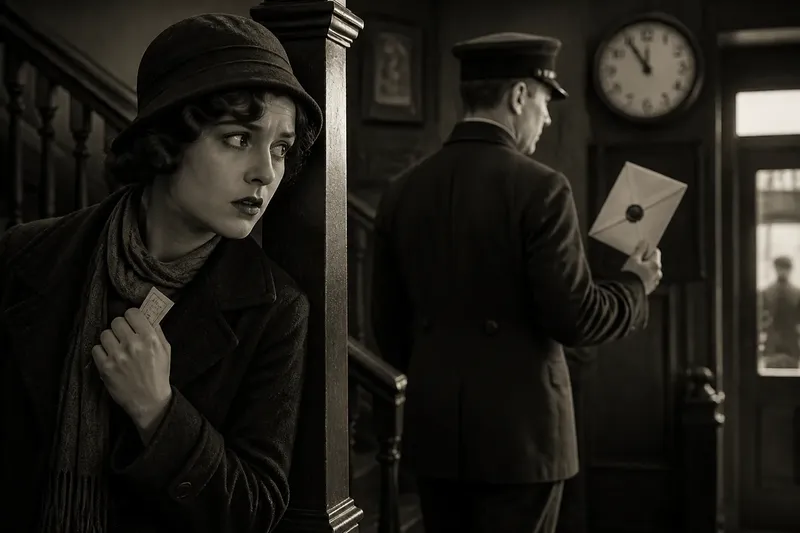
Imagine an invented scene in which a young courier, Lena, must deliver a sealed envelope to a railway station before a train leaves. She arrives at a lodging house, sees a watchman carrying the envelope upstairs, and realises the delivery is at risk. No spoken line is needed to establish the task. A title card can identify the station and the deadline, while a prop and a visible obstacle give the audience something concrete to track.
The scene becomes readable when each detail has a job. The envelope stands for the task; the station clock gives urgency; the watchman creates a problem. If Lena looks from the envelope to the clock and then towards the exit, her attention links those objects into a decision. The viewer is not merely shown three things, but invited to connect them.
That connection is the craft: place information where the audience can notice it, then let the performer respond to it.
What should an intertitle tell us?
An intertitle is a short text card inserted between images. It can supply a name, a necessary fact, a line of dialogue or a shift in time and place. Its value depends on what the image cannot communicate as clearly on its own. A card that explains every movement competes with the scene; one that supplies a missing fact lets the action continue with purpose.
In Lena’s scene, an early card might say that the envelope contains a signed permit needed at the station. That gives the object stakes before it becomes contested. Later, a brief line from the watchman—“The office is closed”—could narrow Lena’s options. The exact words matter less than the information they add. The audience can then watch her assess the locked door, the staircase and the envelope rather than wonder what the errand is about.
Intertitles also shape pace. A card pauses the image for reading, so a filmmaker can use one to give a reveal room to land. But if a title arrives after the image has already made the same point, it can feel like an unnecessary explanation. Read each card as a question: what does this tell the viewer that the visible action has not?
How does gesture carry information?
Gesture works best when it has a clear target. Lena could reach towards the envelope, stop when the watchman turns, and fold her hand back around a ticket. That small sequence makes her intention and restraint visible. A broad, repeated gesture may be needed for a large screen or a distant view, but exaggeration alone does not make a performance clear; the movement must still connect to an object, person or choice.
Direction matters, too. If Lena repeatedly looks towards the station door, the audience learns where she hopes to go. If the watchman’s body blocks that route, the conflict takes physical form. The actors’ positions become part of the information: who controls the envelope, who can leave, and who is watching whom.
Imagine Lena finally distracting the watchman by dropping her ticket. As he bends to retrieve it, she reaches for the envelope. The action is legible because the cause and response occur in view: the dropped ticket draws his attention; his movement opens a brief opportunity; Lena takes it. The viewer can understand the tactic without a card announcing her plan.
How can an object turn into a story?
A prop becomes meaningful through its changing use. At first, the envelope is simply something Lena carries. Once the watchman takes it, it becomes the centre of a struggle. When Lena regains it, she must still decide whether to risk the main stairs or leave by a side passage. The object links the scene’s stages and helps the audience recognise what has changed.
For this to work, the prop must be shown clearly enough to follow. A close view of the seal could establish why it matters; a later view of Lena checking that the seal remains intact could confirm she has recovered the right item. The film need not pause to explain every property of the envelope. It needs only to make its relevant features visible when they affect the action.
Watch for a prop’s role to shift: it may begin as evidence, become an obstacle, then serve as proof that a character has succeeded. That shift can carry a scene’s logic without more text.
What questions help you read a silent scene?
How can I tell what the character wants?
Look for a repeated direction of attention, a handled object or a destination the character keeps approaching. If those details converge, they often reveal the goal before an intertitle names it.
When does an intertitle help rather than interrupt?
It helps when it adds a fact the image cannot make clear, such as a relationship, a deadline or a change of place. If the next action already communicates that fact, the card may be doing the scene’s work twice.
Why might a gesture seem unclear?
The movement may lack a visible target, or another action may distract from it. Follow the performer’s gaze and hands, then check what changes in the scene immediately afterwards.
How do I know whether the scene’s outcome is legible?
Notice whether you can describe the character’s initial goal, the obstacle and the action that changes the situation. If one link is missing, look for a title, prop or response that supplies it.
What changes when Lena reaches the station?
In this invented scene, Lena slips out through the side passage with the envelope and arrives as the train is preparing to leave. She presents the sealed permit to the station clerk, who compares it with a ledger and opens the gate. The result is visible: the envelope changes hands, the gate opens, and Lena boards. A final title could identify the journey’s destination, but the audience already understands that the delivery succeeded.
The scene’s clarity comes from a chain of observable events, not from any single device. The intertitle establishes why the envelope matters; Lena’s gestures reveal her decisions; the route through the lodging house turns those decisions into action; and the clerk’s response confirms the outcome. If the final card adds nothing, the film can end on the opened gate and Lena moving towards the train.
When watching a silent film, track one object and ask how its meaning changes as characters touch, hide, offer or recover it. That simple habit makes the old screen language easier to read—and shows how much story an image can carry before anyone speaks.